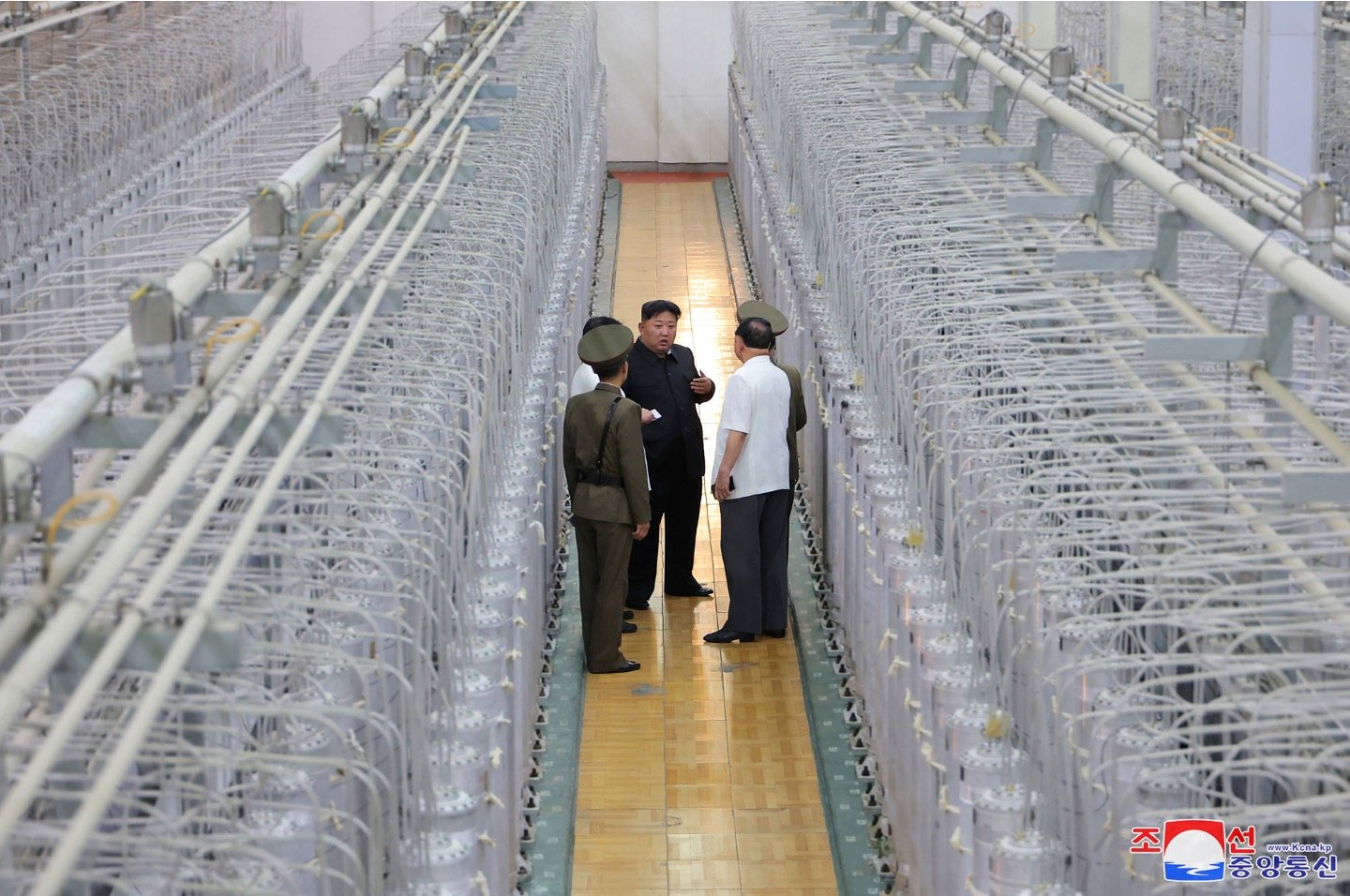
-
<38 North> 2025-6-13, Yongbyon Nuclear Scientific Research Center: A Suspected New Enrichment Facility and Dismantlement of 50 MWe Reactor
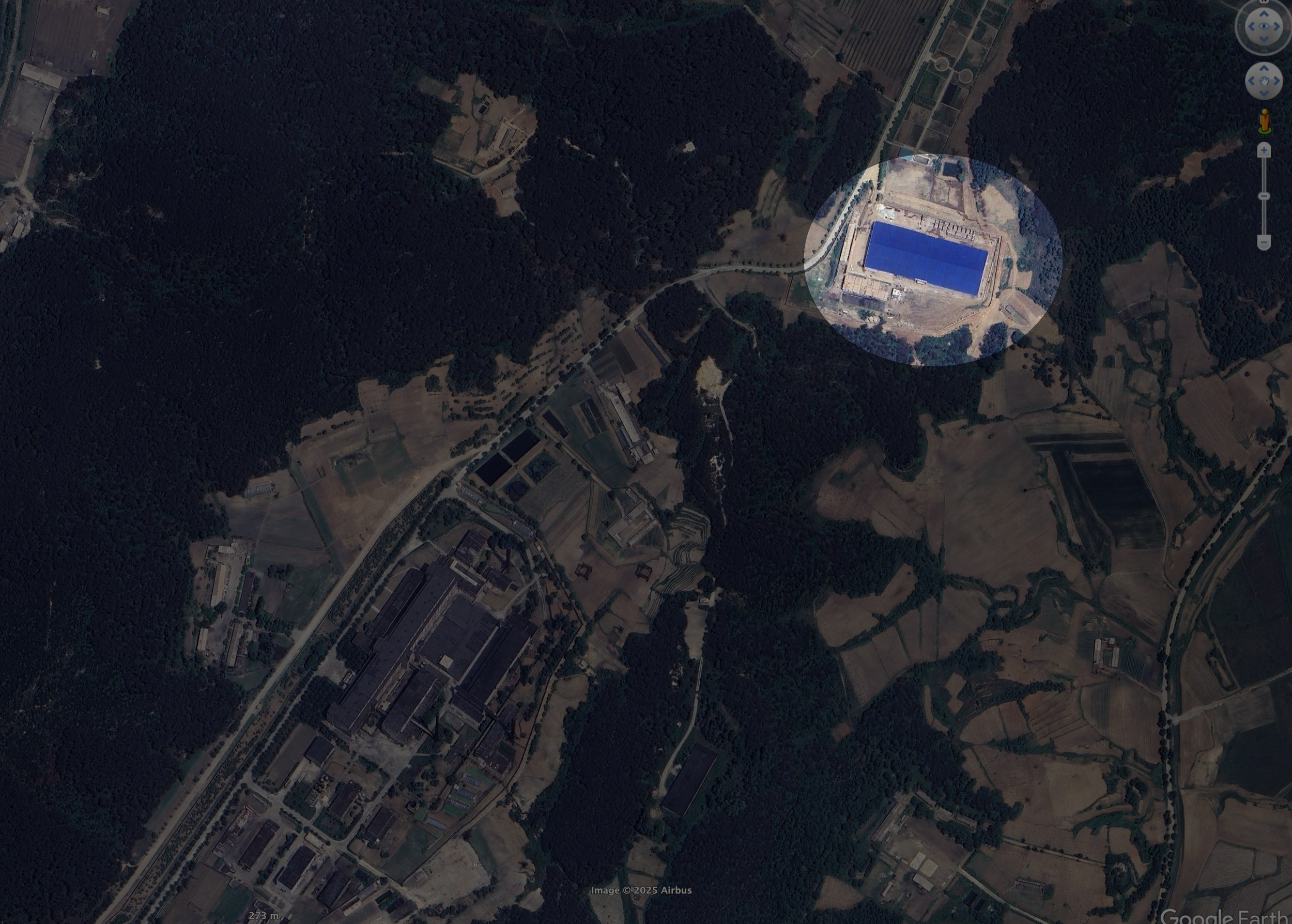
<CSIS> 2025-6-12, Suspected Uranium Enrichment Building at Yongbyon
<ISIS> 2025-6-11, Is North Korea Building a New, Kangsong-Like Building at Yongbyon?
<Middlebury Institute of International Studies at Monterey> 2025-6-10, Suspect Enrichment Facility in the DPRK
<Arms Control Wonk> 2025-6-10, A New Enrichment Plant At Yongbyon?
Source: Google Earth Pro (annotated by DPRK Monitor)
April 27, 2026
Mystery of the Third Site: Focus Shifts to Kusong After Remarks by ROK Unification Minister
- This report covers the proceedings of the 1st Meeting of the Foreign Affairs and Unification Committee (제433회 국회(임시회) 제01차 외교통일위원회) during the 433rd Extraordinary Session of the National Assembly, held on March 6, 2026. The central focus of the session was a statement made by Unification Minister Chung Dong-young (통일부장관 정동영), which has drawn significant attention to the specific location of a suspected third uranium enrichment facility within North Korea.
- Minister Chung's remarks followed a brief response by Foreign Minister Cho Hyun (조현) to a question from opposition lawmaker Kim Gi-hyeon (김기현): Representative Kim questioned if the government officially recognizes the DPRK as a nuclear state, suggesting President Lee Jae-myung has shifted from denuclearization to arms control.
- An excerpt of Minister Chung's remarks is as follows (English translation provided by DPRK Monitor (DM), click here for Korean-English comparison):
- Just the other day, on March 1st, a meeting of the IAEA Board of Governors was held. At this meeting, Director General Grossi presented a situational report on North Korea's nuclear program, which contained very serious findings. To explain what this means, the 5-megawatt nuclear reactor in Yongbyon is currently in its seventh irradiation cycle, which indicates that its operation is ongoing. This cycle began in January 2025, meaning it has already been running for over a year. Over the past 30 years, fuel rods have been removed six times to extract roughly 100kg of plutonium, and it is estimated that about 16kg of plutonium was extracted during the sixth removal last year.
- The reason I state this is an ongoing issue is that Director General Grossi's report also mentioned HEU in Yongbyon(영변), Kusong(구성), and Kangson(강선). While the enrichment level of the Iranian facilities recently destroyed by bombing was 60%, North Korea's current uranium enrichment has reached 90%, which is weapons-grade. Furthermore, the Director General reported that North Korea is expanding this facility by adding another location in Yongbyon. I am emphasizing just how serious this situation is. Therefore, I would like to explain that the core, or the essence, of the President's remarks is that the immediate priority must be to halt and put a stop to these activities.
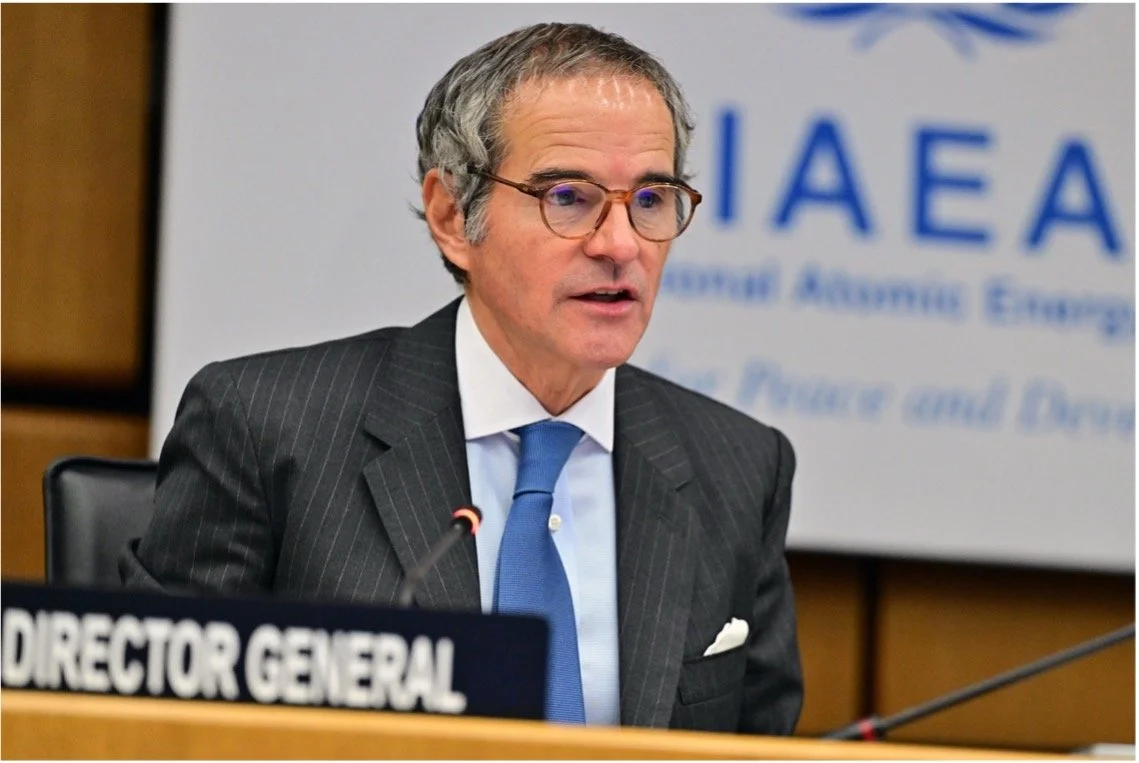
- DM has previously introduced IAEA reports, but in the statement delivered by IAEA Director General Rafael Mariano Grossi on March 2, 2026, he only mentioned Yongbyon and Kangson regarding enrichment facilities.
- DM introduces the region of Kusong, which has been the subject of debate, based on publicly available materials to date (see below).
Kusong: Minister Chung Cites ISIS Research in Identifying Secret DPRK Enrichment Facility
According to South Korean media, Minister Chung stated that his basis for identifying Kusong as an enrichment facility was grounded in reports from U.S. think tanks, such as the Institute for Science and International Security (ISIS).
DPRK Monitor provides an overview of the report by David Albright of ISIS regarding the Kusong site and identifies its location using commercial satellite imagery as follows:
- Location and Significance of the Suspect Facility: Based on a report by the Japanese newspaper Sankei Shimbun, additional information from knowledgeable government officials, and findings made with the assistance of Joseph Bermudez of AllSource Analysis, an early centrifuge research and development (R&D) facility was likely located at the Panghyon Aircraft Plant, at or near the Panghyon Air Base, which is located about 45 kilometers west of the Yongbyon nuclear site. This plant would have served as an important facility in the development of North Korea’s gas centrifuge program in the 1990s and early 2000s.
- Structure and Scale of the Underground Facility: This facility is an underground complex built inside the Changgun-dae Mountain, which is part of the larger Ch’onma-gun mountain range, and has a tunnel entrance wide enough for military aircraft. The suspect site could have held up to 200-300 centrifuges, but there is no information suggesting that this site continues to function as a centrifuge plant.
- Origin of Development and Pakistan's Involvement: Centrifuge research and development in North Korea date back to the late 1990s and early 2000s, and the secret program started after North Korea received significant centrifuge assistance from Pakistan’s A.Q. Khan Research Laboratory, essentially providing them with a "centrifuge starter kit".
- Reason for Choosing the Aircraft Plant: It was North Korean missile experts who learned the technology in Pakistan at that time. Because aerospace and centrifuge technologies often overlap, such as the expertise in high-strength metals needed in gas centrifuges, locating the facility inside an aircraft manufacturing facility would make sense.
- Evading Monitoring and Concealment: Military control of the program at an existing underground military site could better hide the program by isolating it from known nuclear-related sites like Yongbyon, which were being monitored by the International Atomic Energy Agency (IAEA), and better hide it from foreign intelligence services.
- Consistency with Defector's Testimony: A North Korean general who defected in 2001 stated that a facility dedicated to refining uranium was under Mt. Chun Ma, and this geography is consistent with the location of the Panghyon Air Base (27 km south of Kumchang-ri).
Source: Google Earth Pro (annotated by DPRK Monitor)
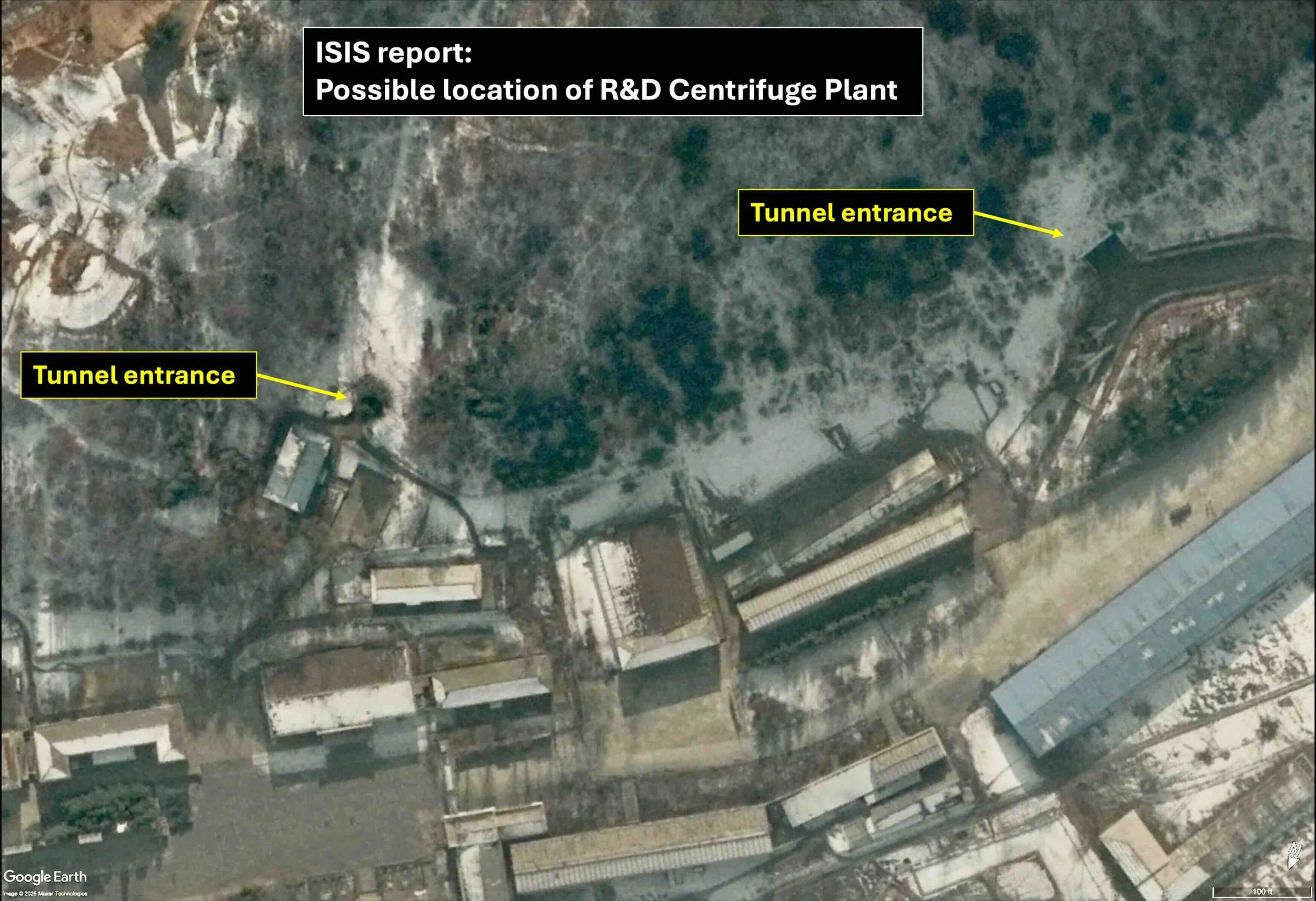
39°53'5.07"N 125°13'59.18"E
Source: Google Earth Pro (annotated by DPRK Monitor)
An overview of the article from the Sankei Shimbun (June 9, 2000)
Sankei Shimbun Article: "Mt. Chonma" in Northwestern North Korea – A Secret Base for Nuclear Production; Uranium Refining Since '89 (北朝鮮北西部「天摩山」 核生産の秘密基地 89年からウラン精錬)
Key Points
Facility Location: The secret nuclear production base is located in a massive underground tunnel system beneath the 1,116-meter Mount Cheonma (Chonma) in North Pyongan Province (평안북도).
Timeline and Output: Construction by military engineers began in 1984 and concluded in 1986. Actual uranium production commenced at the end of 1989. Upon completion, the base produced approximately 1.3 grams of uranium daily, totaling an estimated 5 kilograms over a ten-year period.
Source of Intelligence: The intelligence originated from Lee Chun-sun (이춘선), a 66-year-old former Major General of the Ministry of People's Armed Forces Operations Department and former missile base commander. He revealed the information to Chinese authorities after defecting.
Workforce Composition: The facility operates with approximately 400 personnel. This includes 35 engineers, 100 managers, and manual laborers consisting entirely of political prisoners serving life sentences.
Logistics and Layout: Uranium ore is transported to the site from mines in South Pyongan and North Hwanghae provinces by transport units of the Ministry of People's Armed Forces. The underground complex features a 6-kilometer-long main tunnel with aluminum-paneled walls and ten distinct operational sections, including ore sorting, refining, and packaging rooms. Finished uranium products are airlifted via helicopter to an underground storage facility in Anju (안주).
Environmental Impact and Concealment: Toxic drainage from the base caused environmental damage to forests near Kumchang-ri (금창리), located 30 kilometers to the southeast. Despite conducting nuclear suspicion inspections in Kumchang-ri, the US failed to detect the existence of the Cheonmasan base.
Defector's Fate: South Korean intelligence sources suggest that the whistleblower, Lee Chun-song, was likely repatriated to North Korea by Chinese authorities after attempting to seek asylum in a third country.
Source: Sankei Shimbun
April 13, 2026
CSIS Analysis: Yongbyon Expansion, Satellite Imagery Reveals Completion of Suspected Nuclear Plant
The report by CSIS Beyond Parallel details the completion of a significant new facility at the Yongbyon Nuclear Research Center. Satellite imagery confirms that a building, widely suspected by the International Atomic Energy Agency (IAEA) to be a uranium enrichment plant, is now externally complete and undergoing internal fitting. The facility's dimensions and infrastructure—including power supply and cooling capacity—closely mirror those of the undeclared Kangson enrichment facility. This development indicates a potential expansion of North Korea's nuclear weapons inventory, as any production of enriched uranium would significantly increase the quantity of available nuclear material.
Key Points
Facility Completion and Status: Recent satellite imagery from April 2, 2026, shows the new building is essentially complete with support infrastructure, while internal construction and fitting are likely ongoing.
IAEA Assessment: Director General Rafael Mariano Grossi noted the building has dimensions and features similar to the Kangson enrichment plant, including power supply and cooling capacity.
Construction Timeline: Construction began in mid-December 2024 with concrete footing excavations, was largely externally complete by June 2025, and reached its current state by early April 2026.
Physical Dimensions: The new main building measures approximately 120 by 48 meters (5,760 sq. meters), nearly identical to the Kangson facility's main building which is approximately 115 by 52 meters.
Site Infrastructure: The facility includes standby generators, fuel storage tanks, cooling units, a security wall with fencing, and is supplied by a line of electricity pylons from the north.
Location and Significance: Located 480 meters north-northeast of the Radiochemistry Laboratory, its placement is notable as existing centrifuge halls are located 2 kilometers to the south.
Source: CSIS
March 2, 2026
IAEA Director General's Introductory Statement to the Board of Governors, 2 March 2026, Vienna, Austria
Key Points
5MW(e) Reactor: Continues to operate in its seventh irradiation cycle, indicating steady plutonium production.
Reprocessing Activity: The Radiochemical Laboratory was active from January to September 2025, likely processing irradiated fuel from the reactor's previous cycle.
Uranium Enrichment: Facilities at both Kangson and Yongbyon remain operational. Of particular concern is a new building at Yongbyon with infrastructure (power/cooling) mirroring the Kangson enrichment site.
Light Water Reactor (LWR): After a temporary shutdown (August–November 2025), indications suggest the reactor has resumed operation.
Punggye-ri Nuclear Test Site: No significant structural changes observed, but the site remains in a state of readiness to support a nuclear test at any time.
Full article of the IAEA (Excerpts regarding the DPRK only)
The IAEA continues to monitor the nuclear programme of the DPRK.
The Agency has observed that the 5MW(e) reactor at Yongbyon likely continues to operate in its seventh irradiation cycle. Operation of the Radiochemical Laboratory was observed between January and September 2025, when irradiated fuel from the sixth cycle of the 5MW(e) reactor was likely reprocessed.
The ongoing operation of enrichment facilities at Kangson and Yongbyon is of serious concern. In addition, the Agency is continuing to monitor a new building at Yongbyon which has dimensions and infrastructure, including power supply and cooling capacity, similar to the Kangson enrichment facility. The new building is externally complete and internal fitting is likely underway.
There are indications that the light water reactor (LWR) at Yongbyon continues to operate after a period of shutdown between August and November 2025.
There were no indications of significant changes at the Nuclear Test Site at Punggye-ri, which remains prepared to support a nuclear test.
The continuation and further development of the DPRK’s nuclear programme are clear violations of relevant UN Security Council resolutions and are deeply regrettable. The Agency continues to maintain its enhanced readiness to play its essential role in verifying the DPRK’s nuclear programme.
Source: IAEA.
December 19, 2025
ISIS: Yongbyon Update: Reactors Active, Reprocessing Conducted, New Enrichment Facility Emerging
Key Takeaways (Yongbyon – December 2025)
ELWR operations intermittent, likely resumed: Cooling water discharge from the ELWR was last observed on 8 August 2025, reappeared briefly in imagery dated 13 November, then ceased again for several days. From 24 November onward, water outflow has been consistently visible, indicating a likely resumption of stable reactor operations; it likely generated several kilograms of plutonium in 2024–2025.
5 MWe reactor operating: The 5 MWe reactor continues its seventh operational cycle, with winter imagery confirming active operation through steam emissions and hot water discharge.
Plutonium reprocessing conducted: The Radiochemical Laboratory carried out a reprocessing campaign from late January to September 2025, likely separating approximately 4–6 kg of weapon-grade plutonium.
Spent fuel handling ongoing: Continued vehicle activity at the spent fuel reception building suggests ongoing management of irradiated fuel and possible preparation for further reprocessing.
New enrichment facility suspected: A newly completed, highly secured Kangsong-like building at Yongbyon shows strong indicators of a uranium enrichment plant, potentially expanding production of weapon-grade uranium.
November 19, 2025
IAEA Director General's Introductory Statement to the Board of Governors, 19 November 2025, Vienna, Austria
Key Points
5MW(e) reactor at Yongbyon is likely operating in its seventh cycle, with evidence of fuel reprocessing from the sixth cycle observed in early–mid 2025.
The ongoing operation of enrichment facilities at Kangson and Yongbyon is of serious concern.
A new building under construction at Yongbyon, similar in size and features to the Kangson enrichment plant, may indicate additional enrichment capacity.
The Yongbyon light-water reactor (LWR) appears to have operated stably until early August 2025, but was likely shut down thereafter.
No major changes were observed at the Punggye-ri Nuclear Test Site, which remains ready for a nuclear test, underscoring continued violations of UN Security Council resolutions.
Full artcile of the IAEA (Excerpts regarding the DPRK only)
The IAEA continues to monitor the nuclear programme of the Democratic People’s Republic of Korea.
The Agency has observed that the 5MW(e) reactor at Yongbyon likely continues to operate in its seventh cycle. Between January and September 2025, indicators were observed at the Radiochemical Laboratory consistent with the reprocessing of a core load of irradiated fuel from the reactor’s sixth operating cycle.
The ongoing operation of enrichment facilities at Kangson and Yongbyon is of serious concern.
In addition, the Agency is continuing to monitor the construction of a new building at Yongbyon which has dimensions and features similar to the Kangson enrichment plant.
There are indications that the light water reactor (LWR) at Yongbyon continued in stable operation until early-August 2025 but has likely been shut down since then.
There were no indications of significant changes at the Nuclear Test Site at Punggye-ri, which remains prepared to support a nuclear test.
The continuation and further development of the DPRK’s nuclear programme are clear violations of relevant UN Security Council resolutions and are deeply regrettable. The Agency continues to maintain its enhanced readiness to play its essential role in verifying the DPRK’s nuclear programme.
Source: IAEA.
August 21, 2025
IAEA Director General’s Report on DPRK: Plutonium production continues, Uranium enrichment points to expanding capacity
Uranium Mining and Milling (Pyongsan)
Continued indications of mining, milling, and concentrate production activities were observed at the Pyongsan uranium mine and concentrate plant, consistent with prior years.Conversion and Fuel Fabrication
Renovation of the UF₄ Production Process Building was completed and the facility appeared operational by October 2024. Ongoing activities were also observed in other buildings, including four newly constructed facilities — two of which are secured within a common perimeter — that exhibit features consistent with chemical processing.Uranium Enrichment (Kangson and Yongbyon)
The Kangson complex was confirmed to contain cascades of gas centrifuges — twelve cascades, each consisting of 344 centrifuges — consistent with the production of LEU, although the possibility of HEU production elsewhere at the site cannot be excluded.At Yongbyon, the enrichment facility was confirmed to have expanded cascades in its original hall (Hall 1, six cascades), the 2013 extension (Hall 2, eight cascades), and the 2021–2022 annex (six cascades). The cascades, each of 344 centrifuges, remain configured for LEU production, and the facility continued operations during the reporting period. Centrifuges at both Kangson and Yongbyon appeared of the same type, with no indication of advanced centrifuge installation.
In December 2024, satellite imagery showed the start of construction on a new two-storey building southwest of the 50MW(e) reactor at Yongbyon. By May 2025 the structure was externally complete, though work on surrounding support facilities was still ongoing. The building’s layout and dimensions closely resemble those of the Kangson enrichment facility, suggesting a similar potential function.
Reactors (Graphite-moderated and Light Water Reactor)
The 5MW(e) Experimental Reactor at Yongbyon continued operations, with a shutdown of about 60 days between August and October 2024 sufficient to allow refueling, indicating the start of a seventh operational cycle. The LWR was shut down in September and October 2024, and again for much of April 2025, with brief additional shutdowns occurring intermittently thereafter.Reprocessing (Radiochemical Laboratory)
The steam plant serving only the Radiochemical Laboratory became fully operational by late January 2025 and has since run almost continuously, consistent with reprocessing of irradiated fuel from the 5MW(e) reactor’s sixth operational cycle. Additional waste management infrastructure was installed near the facility.Nuclear-powered Submarine
In March 2025, the DPRK showcased the construction of a “nuclear-powered strategic guided missile submarine” at a shipyard in Sinpho. While imagery confirms a submarine hull under construction, the Agency is unable to verify whether a reactor has been developed or installed.Weaponization and Nuclear Testing (Punggye-ri)
The Punggye-ri nuclear test site remains in a state of readiness to support a nuclear test, though no significant new activity was observed during the reporting period.
Source: IAEA.
June 9, 2025
New construction activities in Yongbyon
Source: Google Earth Pro (Annotated by DPRK Monitor)