Testimony
August 25, 2026
Inside North Korea's Customized Android: The "Red Flag" Surveillance System
A KBS documentary in South Korea details how smartphones have spread in North Korea and the surveillance that comes with them. As South Korean dramas and music quietly spread via USB drives and SD cards, North Korean authorities have introduced a censorship system called "Red Flag," built into smartphones, that automatically deletes inappropriate files, among other tightening controls.
In connection with this program, the following outstanding prior research deserves mention. Martyn Williams, a 38 North expert ERNW Security Analyst Niklaus Schiess, Project Reveal: New research into North Korea's digital control system. And one of the authors of this report, Martyn Williams was also interviewed by KBS.
Summary
1. Smartphone Penetration and Types in North Korea
North Korea's mobile communications have expanded significantly, with mobile phone subscriptions reaching 7.85 million by the end of last year, representing a 29.5% penetration rate of the population. To support this growing user base, North Korea even began rolling out a 4G network in 2023.
The state has released more than 20 types of smartphones since launching its first model, the Arirang (아리랑), in May 2013. Other prominent brands include Jindallae (진달래) and Samtaesong (삼태성). Among the newer devices are the Samtaesong 8 (삼태성 8) and the red-colored *Haeyang 701 (해양 701), both identified as 2023 models. While these devices feature modern conveniences like electronic payment and transfer apps, they are strictly restricted to the national intranet and cannot access the global internet.
Defector Testimony: The essential role of phones in daily life is highlighted by Jeong Si-u (정 시우), a defector of the "Jangmadang" (market) generation who defected in 2017:
"To make friends with peers, you absolutely must have a phone. And people are categorized based on whether they use a smartphone or a 2G phone... That’s why there is a saying in North Korea that except for the stray dogs, everyone has a hand phone."
Jeong also shared the unique, highly calculated peer dynamics and safety measures young people use when sharing smuggled South Korean dramas on these devices:
"I had about three incredibly close friends, and among the three of us, we would just rotate and watch dramas whenever we got them. But with other friends outside that circle, we did a strict one-to-one exchange. If I copied an 18-episode drama for them, they had to give me an 18-episode one in return. Why? Because if that person gets caught by the crackdown officers while watching it, they won't snitch on me. Since they also gave me content in return, they know we are both in this together."
2. Censorship and Surveillance Features: Old vs. New
The North Korean regime's digital control over smartphones has grown increasingly sophisticated, transitioning from simple network blockades to active, device-level surveillance and file deletion.
- The Old System (Early Devices): In the early days of smartphone adoption, North Korean devices lacked an integrated file-signature verification system. Users could easily copy smuggled media files—such as South Korean dramas stored on microSD cards—directly onto their phones and play them back without restriction.
- The New System ("Red Flag" System): To counter the massive spread of foreign media, North Korea began distributing a heavily modified Android operating system around 2015 containing a signature system known as "Red Flag 1.0" (붉은기 1.0). This system inspects every file on the device. If a video file does not carry a state-approved electronic signature, the operating system automatically deletes the file and blocks playback.
- Crucially, this censorship software is constantly being upgraded. When researchers analyzed the two 2023 smartphone models obtained by the film crew (the Samtaesong 8 and the Haeyang 701), they discovered that the devices were actually running different versions of the Red Flag software, confirming that the regime is continuously refining its digital surveillance.
- Constant Screen Monitoring: Modern devices are equipped with a pre-installed app called Yeollam Ryeok (열람리력 - "Browsing history"). This app automatically takes screenshots of the user's screen every 5 to 10 minutes. Crucially, users have no way to access these captured images or check what has been recorded.
- Text and Language Censorship: Text messaging (tongmun) features heavy censorship of South Korean words and slang. Typing "남한" (South Korea) automatically converts the text to "괴레 지역" (puppet region), and typing "한국" (Korea) masks the word entirely with asterisks. Additionally, South Korean slang is blocked; typing the word "오빠" (Oppa) automatically changes it to "동지" (comrade), accompanied by a warning message stating the term can only be used among family members and warning married couples not to use it.
Defector Testimony: Jang Hyuk (장 혁), a former North Korean software engineer who defected in 2020, explained the transition:
"Because there was no signature system in the early days, South Korean wave content easily spread on a large scale, especially among the young generation... This signature system [Red Flag] checks whether the content is approved by the state. If the North Korean regime determines it is unwanted content, it deletes it immediately."
3. Group 109: Explanation and Role
Group 109 (109 상무) is a highly feared specialized enforcement task force dedicated to eradicating foreign media and "reactionary" cultural influence. The group's name originates from October 9, 2004, the date Kim Jong-il issued a directive to eradicate foreign culture.
Unlike local police, Group 109 is dispatched directly from the central government, giving them sweeping powers. They can launch surprise raids on households at any time and immediately arrest citizens. Under draconian laws like the 2020 Reactionary Ideology and Culture Rejection Act, the regime has escalated the penalties for watching or distributing South Korean media, with punishments now reaching up to the death penalty. While minor infractions were previously bypassed using bribes, defectors report that crackdown enforcement has become so severe that bribery is no longer a viable escape.
Defector Testimonies: A defector named Kang Gyu-ri (강 규리), who had to pay a $150 bribe after being caught with recorded South Korean songs around 2018, described the terror they inspire:
"The 109 Group is a subject of absolute fear. Just seeing them pass by makes my heart pound."
A former crackdown officer of Group 109, who subsequently defected, described their aggressive interrogation methods and the state's ideological motivations:
"We hit them with the back of our hands and stepped on their legs to make them confess... If they fall for that ideology [by watching how well people live outside], they will forget their leader, the party, and the state, and only think about feeding themselves... Now that I look back, they were all pitiful people trying to make a living, and I feel like I sinned."
Furthermore, Yang Il-cheol (양 일철), who defected from Pyongyang in 2025 and spent a year in a labor camp (gyowaso) for watching foreign media, emphasized the tightening grip of the law:
"Paying money to escape [after being caught with South Korean movies] is old news... If caught now, you just think you're dead."
Source: KBS documentary, 와..이래서 북한이 목숨 걸고 숨겼나.. USB에 담겨 있던 충격적인 영상이 공개됐다 | KBS 시사기획 창20260707 방송
If you type "South Korea" (남한), it gets automatically converted to "puppet region."
And if you type "한국" (Hanguk/Korea), it gets completely blocked out with asterisks.
Source: KBS (annotated by DM)
Files approved (signed) by the state carry a red star (Above Left).
What stands out is that the two smartphones we obtained have different versions of "Red Flag." Its censorship capabilities keep improving (Above Right).
Source: KBS
August 18, 2026
Smartphones and Supermarkets: Global Trends Meet Local Life in Pyongyang
An interview with Heo Yong-ho (許勇虎), Vice Chairman of Korean commercial workers in Japan (在日本朝鮮商工連合会) posted on X, who visited Pyongyang this April, shows just how much everyday life in North Korea is changing.
Private car ownership — once tightly restricted — is now permitted, with used car dealerships popping up across the capital. Cities are going cashless fast, powered by QR code payments, while food delivery has become an everyday habit for young North Koreans. Meanwhile, homegrown brands are winning trust over foreign imports, from groceries to household goods. Add a construction boom reshaping the skyline, and a very different, more modern North Korea comes into view.
Source: X
Location of Office 39 (39호실)
According to the information obtained from reliable source by DPRK Monitor, Office 39's location is 39° 0'57.96"N 125°44'24.48"E.
Source: Google Earth Pro
Foreign Currency Earning by Office 39 (39호실)
DPRK Monitor introduces a piece in which South Korean media clearly summarize defector testimony and expert commentary on the activities of Office 39, the bureau responsible for North Korea's foreign currency earnings.
Office 39 manages a diverse range of illicit and exploitative revenue streams:
- Service & Art: Mansudae Art Studio (만수애창작사, KPe.050) creates high-end artworks, including paintings and intricate embroidery, which are sold for $5,000 to $10,000 each. While a portion of the proceeds is given to the artists, the rest is collected by North Korean restaurants or funneled directly back to the state.
- Counterfeit Goods: Office 39 oversees the production of counterfeit high-end Dunhill cigarettes, which generate up to $700 million in profit through Chinese and the South East Asian markets. They also attach fraudulent "Made in Korea" labels to North Korean-made clothing to bypass international bias and increase sales.
- Regarding the sale of one ton of expired butter, the sources describe a specific instance of "creative" foreign currency earning carried out by a North Korean diplomat:
- Acquisition of Waste (butter): A North Korean ambassador learned of one ton of butter in a foreign country that was nearing or had already passed its expiration date and was scheduled for disposal.
- Fraudulent Relabeling: Instead of the butter being destroyed, the North Korean embassy acquired it and tampered with the labels to extend the expiration date.
- Rebranding and Resale: The expired butter was rebranded as premium products from countries like France or Switzerland and then resold in markets across China and Southeast Asia.
- State Recognition: For successfully generating funds through this illicit scheme, the ambassador was highly praised by the regime and awarded.
- Labor-Intensive Exports: Following sanctions on minerals, the regime has pivoted to exporting wigs and false eyelashes to China, which became their top export item in early 2024.
- Arms Dealing: They engage in large-scale weapon smuggling, including missiles and RPGs to the Middle East and the Wagner Group.
Harsh Quotas for Overseas Workers and Diplomats
The regime exerts extreme pressure on its citizens abroad to meet financial targets:
- Overseas Workers: Approximately 100,000 workers controlled by Office 39 are sent abroad before COVID pandemic.
- They are often working 12-hour shifts in extreme conditions, such as 50°C heat in the Middle East. The state seizes over 80% of their wages; for example, from a 650,000 KRW ($ 439) monthly salary, 520,000 KWR (351) is taken by the government as "loyalty funds".
- Diplomats: Modern North Korean diplomats now spend 90% of their time on foreign currency earning rather than traditional diplomacy. They are forced into a "loyalty competition," where success (e.g., earning $1 million) leads to being treated as a "Hero" with a luxury apartment, but failure or getting caught results in recall and potential labor camp sentences.
- Smuggling Tactics: To transport cash, workers and diplomats hide money in backpacks or inside food containers, such as jars of fermented soybean paste, to avoid detection at customs.
Luxury Spending for the Kim Family
The funds generated by Office 39 support a decadent lifestyle for Kim Jong Un and his family:
- High-End Fashion: Family members are seen in luxury brands, such as Kim Ju-ae's Dior coat and Ri Sol-ju’s collection of Chanel bags.
- Collections & Hobbies: According to a former the ROK intelligence service (NIS) expert, Kim Jong Un seems to have childish/infantile tastes and spends approximately $8.5 million (12.7 billion KRW) annually on game machine, model cars and model planes and $6 million (9.3 billion KRW) on high-end bicycles, etc.
- Palatial Residences & Equipment: The regime maintains about 30 luxury villas (특각); a single renovation of No. 15 residence (15호 관저) in Pyongyang cost roughly $120 million (168 billion KRW). He also owns an 80-meter yacht with a swimming pool and has recently sought to purchase dog sleds from Russia.
Total annual spending on these luxury goods is estimated to be between 600 and 700 billion KRW (approximately $450–$530 million).
Source: 이만갑 608회 (2023-08-27)
Proceeds from artwork sales shared between Mansudae Art Studio and restaurant revenue
According to NIS analysis, Kim Jong Un has childish/juvenile tastes
Residence No. 15, formerly owned by Kim Jong Il.
DM comments: According to ROK media (SBS), Residence No. 15 (39° 0'57.02"N 125°44'45.30"E) — the place where his birth mother once lived, and where he spent his childhood. And Under former President Yoon, South Korea's Drone Command allegedly sent drones targeting Residence No. 15 — Kim Jong Un's residence — in Pyongyang in October 2024.
KJU Owns more than 30 special villas (특각)
Source: Images are from 이만갑 608회 (2023-08-27) (translated by DM)
Inside Kumchang-ri's "Underground Palace": A Defected Colonel's Testimony on North Korea's Secret Nuclear Site (Part 2)
Following Part 1, this section presents the continued testimony of Colonel O Cheol-yong (오철용).
- He also testified about the harrowing labor conditions at nuclear facilities (Such testimony has also been referenced in past defector memoirs).
- Also appearing on the program was Ryu Hyun-woo (류현우), North Korea's former chargé d'affaires (acting ambassador) to Kuwait, who defected in 2019. He identified a location where nuclear physicists from Russia and other former Soviet states reportedly resided in an apartment near his home for several years following the collapse of the Soviet Union (39°2'4.11"N 125°47'55.61"E).
- In addition, Puhung Trading (부흥무역) is a trading company operated to secure funding sources for 131st Bureau.
Brutal Working Conditions and Human Casualties (Statements by Colonel O Cheol-yong)
At nuclear development sites, hazardous work is carried out with inadequate protective equipment, resulting in serious health damage.
Deplorable mining conditions: At uranium mines, work is conducted at depths of 2,000 to 4,000 meters underground, with workers wearing only masks and helmets and no protective suits.
Radioactive contamination and the "50-year-old hwangap": Soldiers working at nuclear facilities such as Yongbyon age so severely that they lose their teeth and go gray-haired in their forties. Because of this, there is a tragic local custom of celebrating the hwangap (還暦, the traditional 60th-birthday milestone) at age 50 instead of the usual age 60.
Desperate concealment operations: Ahead of an inspection by the International Atomic Energy Agency (IAEA), there is an account of roughly 100 workers, without protective suits, manually removing highly radioactive (liquid) waste using buckets. It is reported that everyone involved in this operation died within ten years.
Recruitment of Nuclear Experts from former USSR (Statements by Ambassador Ryu)
- After the collapse of the Soviet Union in the early 1990s, North Korea appears to have housed senior nuclear physicists from Russia and Ukraine in an apartment near Pyongyang for several years.
The Reality of Puhung Trading (부흥무역) (Statements by Ryu)
Puhung Trading (부흥무역) is a trading company operated to secure funding sources for 131st Bureau. Working for this company carried significant advantages: while military service in North Korea typically lasts many years, employees who served three years at Puhung Trading were granted admission to the Workers' Party of Korea, making it a popular posting for the children of senior officials.
DM's Supplementary Notes on Puhung Trading
- Puhung Trading itself has not been designated for asset freezes under UN Security Council sanctions. However, reports of the DPRK Panel of Experts describe an entity called Korea Puhung (General) Trading Company — which includes the name "Puhung Trading" — as linked to the Munitions Industry Department (KPe.028), North Korea's ballistic missile development organization, which is subject to a UN asset freeze. The reports document this entity's activities in Vietnam involving the export of North Korean coal and titanium ore, as well as the chartering of vessels.
- Separately, Japan has designated an entity believed to be Puhung Trading — Korea Puhung Trading Corporation (朝鮮富興貿易会社) — as an organization linked to WMD and missile development.
- Australia has also independently designated the same entity under its own sanctions regime, listing it on the Department of Foreign Affairs and Trade's Consolidated List (Reference number 6690).
Apartment of Former Soviet Nuclear Physicists
Source: Google Earth Pro (annotated by DM)
DPRK Monitor provides an additional explanation of Kumchang-ri's UGF.
40° 7'5.68"N 125° 7'58.63"E
Source: Google Earth Pro (annotated by DM)
Based on information of the ISIS’s Solving the North Korean Nuclear Puzzle and Arms Control Wonk, the UGF layout appears to be as described above. The facility features an intersecting grid of four north-south tunnels and 17 east-west tunnels. While satellite imagery shows structures that seem to connect to the underground facility, DPRK Monitor has not confirmed whether these are the actual entrances and exits to the UGF.
Source: Google Earth Pro (annotated by DM)
Inside Kumchang-ri's "Underground Palace": A Defected Colonel's Testimony on North Korea's Secret Nuclear Site (Part 1)
Introduction
- DPRK Monitor (DM) introduces the testimony given to South Korean media "Channel A (채널A)" by Colonel O Cheol-yong (오철용), who defected in 2020. He worked at the 131st Bureau (131 지도국), which handles uranium mining, the construction of nuclear-related facilities, support for the technicians and military units engaged in these tasks, and foreign currency earning activities.
- An interesting point in Colonel O's testimony is that the Kumchang-ri (금창리) underground facility was built specifically for nuclear use. It was constructed over approximately 10 years starting from the early 1990s, mobilizing about 10,000 personnel. The interior is reportedly so massive that it is referred to as an "Underground Palace" (The size of the facility is also noted in David Albright’s book, Solving the North Korean Nuclear Puzzle).
- Additionally, Colonel O testified about how information regarding the facility leaked to South Korea and the United States. A female military official, who had no authority to visit, toured the Kumchang-ri underground facility and spoke about its existence to an acquaintance who was the president of a trading company affiliated to 131st Bureau.
- Colonel O also worked for six months at Pyongsan, a North Korean uranium mine. He testified about uranium mine production and the poor working conditions in 1992, when soldiers went to Yongbyon to process radioactive waste during the IAEA inspections.
- DM notes that the Kumchang-ri underground facility was suspected of being a nuclear-related facility in 1999, leading to allegations that North Korea had violated the Agreed Framework (signed between the U.S. and North Korea in 1994). Although a U.S. delegation visited the site, no definitive proof was found that it was a nuclear facility.
- DM believes that the testimony from someone belonging to a unit deeply involved in the construction of such facilities—confirming that the Kumchang-ri facility was indeed a nuclear-related facility as originally suspected—is extremely important. Since the content is extensive, it will be introduced in two parts.
David Albright’s book, Solving the North Korean Nuclear Puzzle (page. 173) puts it as folllows:
The nine kilometers of tunnels were laid out in a grid-like pattern, with 17 longer tunnels crossed by four shorter ones, with entrances on each end. The proportions of the tunnels were approximately 40 meters wide by six meters high. Almost all of the tunnels were composed of bare rock, and it was evident that the site took at least a decade to excavate.
Roles of the 131st Bureau (131 지도국)
The 131st Bureau is one of the units in which Kim Jong Un places the most trust; it was named after its founding date, January 31st. Its main roles are as follows:
- Management of the entire nuclear development process: It handles everything from uranium mining and transport to the establishment of production processes and the construction and management of nuclear facilities.
- Monopoly on specialized technology: The unit possesses its own technical teams necessary for nuclear development and is responsible for all practical nuclear-related matters, including uranium refining, the setting up of nuclear test sites, and the management of nuclear facilities.
- The Supreme Leader's "Praetorian Guard" (친위대): The bureau plays such a central role in nuclear development that the late General Secretary Kim Jong Il once stated, "Nuclear weapons are the Supreme Commander myself, and the 131st Bureau is my Praetorian Guard (친위대)".
The Reality of the Kumchang-ri Facility
The Kumchang-ri facility caused great suspicion in the international community in the late 1990s, and its internal reality was that of a large-scale underground nuclear facility.
- Camouflage and Suspicion: On August 17, 1998, reporter David Sanger of the New York Times, known for many excellent reports on these issues, brought the suspicion to light by reporting "NORTH KOREA SITE AN A-BOMB PLANT, U.S. AGENCIES SAY." The North Korean side claimed it was a "rice warehouse" and extracted a large amount of food aid from the US in exchange for an on-site access.
- Scale of Construction: It took about 10 years to build, starting from the early 1990s, with approximately 10,000 personnel mobilized. The interior is so vast it is called an "Underground Palace".
- Information Leak and Crackdown: Although the facility's secrets were strictly kept, information leaked after a female director of a "Gunsang" (군상, a store for military personnel) under the 131st Bureau witnessed the interior while accompanying a political officer. She apparently spoke about the contents to the president of a trading company who had suggested she see the underground facility, which was then discovered by North Korean authorities. The North Korean authorities' assessment was that the information had leaked to the South Korean Agency for National Security Planning (안기부, now the National Intelligence Service) and the US.
- Abandonment of the Facility: Because the information leaked just before its completion as a nuclear facility, the North Korean side was forced to suddenly abandon the use of the facility.
Source: [이제 만나러 갑니다] 746회 (2026‑04-26)
Colonel O Cheol-yong
Source: Channel A
Image of Kumchang-ri underground facility visited by a female director of a "Gunsang"
Source: Channel A
Beyond the Sanctions: Long-Time Diplomat and Personal Luxury Car Buyer for Kim Jong Un Defects
Summary
The Sourth Korea media "Channel A (채널A)" introduces the defection story and current activities in South Korea of Kim Chol-song, a former North Korean diplomat who was tasked with importing Kim Jong-un's exclusive luxury cars. While serving as the Deputy Representative for Economic Affairs in St. Petersburg, Russia, he realized the imminent threat of North Korea's guilt-by-association system—even for the elite—after his relative was punished for distributing Bibles. To protect the future and freedom of his then 11-year-old son, he fully utilized his diplomatic privileges and personal connections to successfully seek asylum in South Korea with his family in an exceptionally fast timeframe of just two days. Currently in South Korea, he is dedicating his efforts to improving North Korean human rights issues and rescuing North Korean soldiers mobilized in the Russia-Ukraine war.
Profile and Activities of the Guest
- Name: Mr. Kim Chol-song (김철성)
- Period: He was stationed abroad from 2007 to 2016.
- Location: St. Petersburg, Russia.
- Activities:
- He served as the Deputy Representative of the Economic and Trade Counselor's Office in St. Petersburg, representing the North Korean Ministry of External Economic Relations.
- He managed North Korean foreign currency-earning enterprises and construction workers dispatched to Russia, and held the authority to approve or deny North Korean businesses trying to enter the Russian market.
- He acted as a highly trusted "personal shopper" for Kim Jong-un, directly importing luxury foreign vehicles (like Mercedes-Benz) and personal items exclusively for the Kim family.
- On a personal business level, he imported Russian Baltika beer into North Korea to meet his foreign currency-earning quotas.
Items Transported to North Korea and Smuggling Methods
- Items Transported: He imported a total of nine luxury vehicles, including Mercedes-Benz cars, and buses for Kim Jong-un and his bodyguards. He also transported small daily necessities, such as soap boxes and combs used by the Kim family.
- Methods:
- Using Foreign Intermediaries: Because of international sanctions, he could not purchase these items legally. He used foreign nationals (from China, Singapore, the Netherlands, etc.) and their bank accounts to buy the cars and transfer funds.
- Route Laundering: To avoid tracking, the cars were repeatedly bought and sold among foreigners and moved through multiple countries, acting like money laundering. For example, a car might go from the Netherlands to the UK, Singapore, Macau, Japan, Busan (South Korea), and finally Vladivostok (Russia).
- Delivery into North Korea: From Vladivostok, the vehicles were airlifted directly to Pyongyang using transport planes. Alternatively, vehicles were driven to Dandong, China, where North Korean guards would take over and drive them into North Korea using "Route 123," an exclusive road for the Kim family.
- Evading Inspections: To ensure utmost secrecy, smaller personal items for the Kim family were handed over in person in places like Dandong, specifically avoiding any X-ray security checks.
Companies Associated with Mr. Kim Chol-song.
- Ministry of External Economic Relations (대외경제성): The North Korean government ministry he belonged to.
- Myong-o Trading Company (명오무역회사, 명오37): A company affiliated with the Kim family's bodyguard unit. He worked with its 2nd Department, which exclusively handled imports for the Kim family.
- Baltika Brewery (발티카): A Russian beer brand that he personally imported into North Korea as a business venture.
- Mansudae Art Studio (만수대창작사): A North Korean art production company. He was involved in rejecting their attempt to establish a branch in Russia to sell paintings, having determined that North Korean artistic styles would fail to gain traction in a country with a deep appreciation and sophisticated taste for fine arts.
Precautions for North Korean Diplomats Operating Abroad
- Avoiding South Korean Internet Services: Diplomats are careful not to use South Korean platforms like Naver or Daum. Because these are South Korean brands, there is a significant risk that South Korean intelligence agencies could track their IP addresses and locations.
- Using Google Instead: When they need to access South Korean news (such as Yonhap News) for research or cross-checking information, they use Google to avoid direct tracking by South Korean platforms.
- Encrypted Communications: Any directives from Kim Jong-un are sent using encrypted messages. This is to prevent foreign intelligence agencies (like those from the US or China) from intercepting the content.
- Secrecy to Prevent Sabotage: Import details are kept strictly secret to ensure that foreign intelligence agencies do not secretly plant tracking chips or listening devices inside the imported cars or electronics.
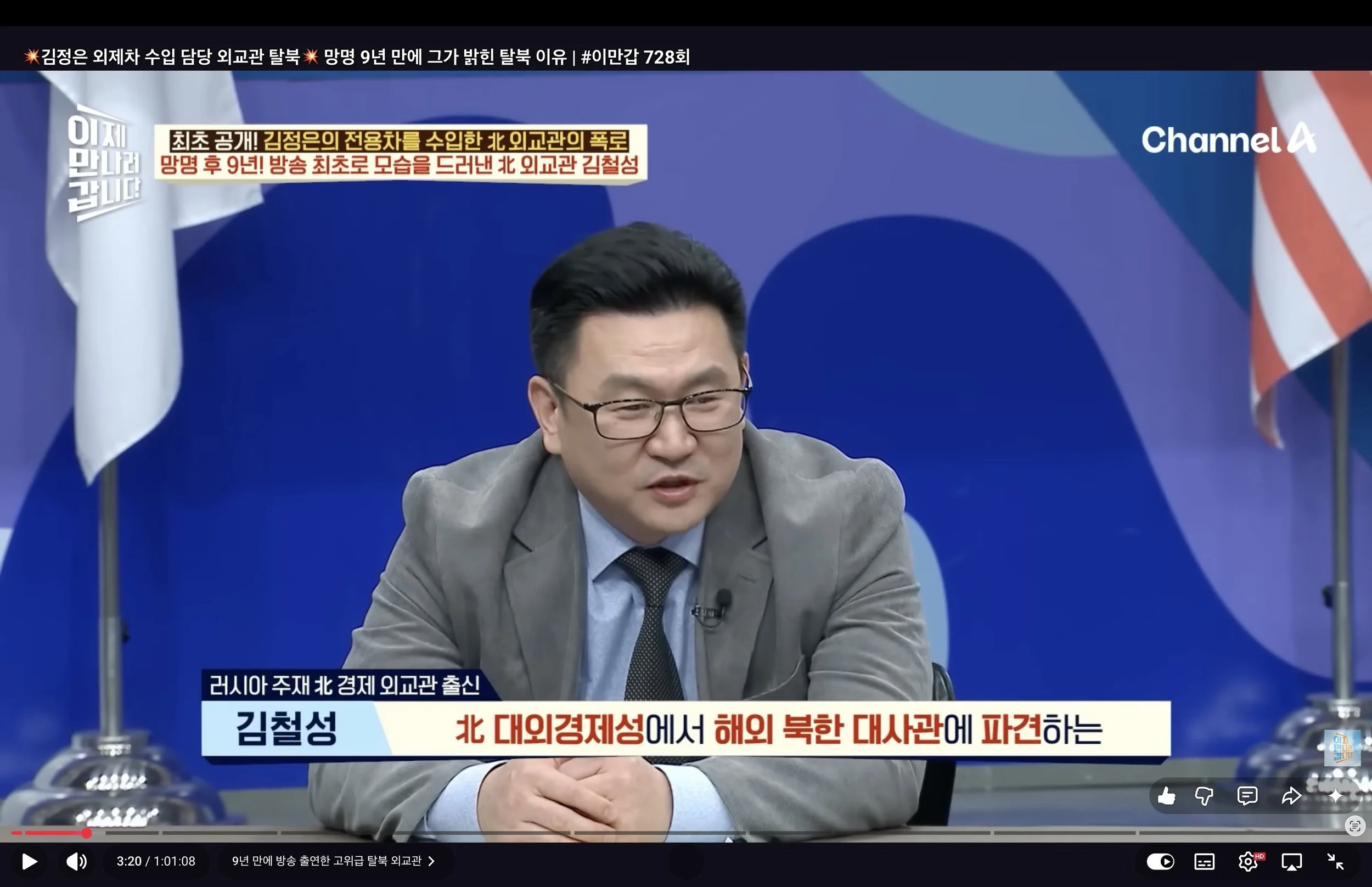
Mr. Kim Chol-song
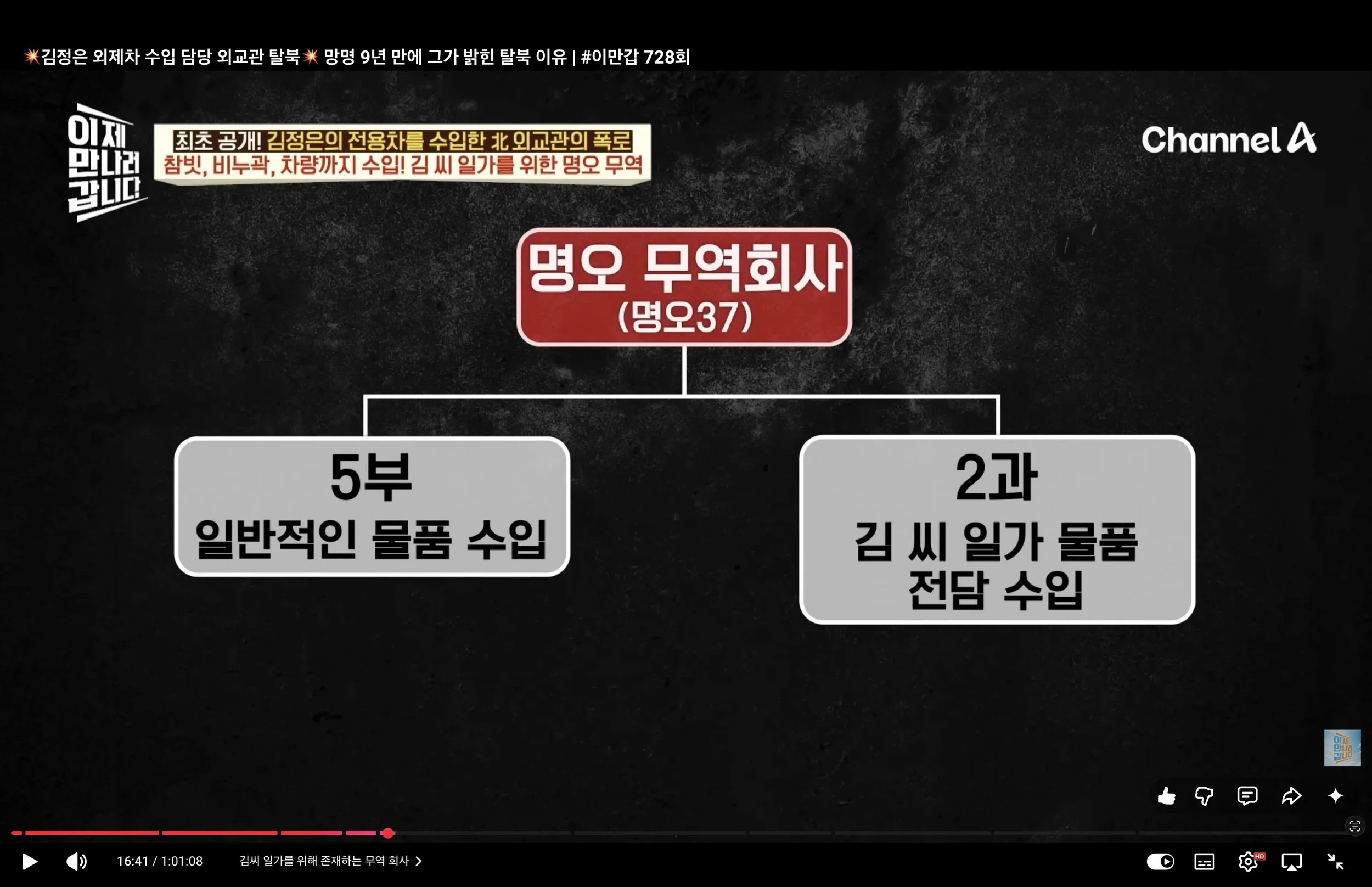
Myong-o Trading Company structure
January 25, 2026
RFA Resumes Broadcasts to North Korea (Reuters)
Significant Resumption
The resumption of broadcasts to North Korea is of great importance, following their suspension in 2025 due to a decision by the Trump administration.Strategic Importance
Regarding the critical role RFA plays in broadcasting to North Korea, DPRK Monitor highlights an article from The Diplomat titled, "Why Strengthening RFA Is a Strategic Imperative for US Policy on North Korea."A Powerful Perspective:
This article was authored by Eunsook Jang, a Fulbright Scholar and North Korean defector. It delivers a deeply persuasive and powerful message regarding the profound impact that the influx of foreign information has on the citizens of North Korea. An overview of the article is provided below.
Summary of Eunsook Jang, The Diplomat, "Why Strengthening RFA Is a Strategic Imperative for US Policy on North Korea"
The recent suspension of Radio Free Asia (RFA) news operations is a significant strategic error for U.S. foreign policy regarding North Korea.
Following a March 2025 executive order that restricted the organization, RFA was forced to halt operations in November 2025 for the first time in nearly three decades.
The author, a North Korean defector, emphasizes that independent information serves as a powerful, non-coercive tool that dismantles state indoctrination, empowers the "Jangmadang Generation," and challenges the Kim regime’s ideological monopoly.
Strengthening RFA is framed as an essential move for U.S. security interests and long-term regional stability.
Eunsook Jang’s Personal Transformation
Shattering 14 Years of Indoctrination: After growing up for 14 years consuming nothing but state propaganda, Jang’s entire worldview was dismantled by watching a single Indian movie.
Discovery of an "Unimaginable" Reality: In the film, she witnessed a lawyer fighting to defend a citizen against the state; this was a concept she found completely "unimaginable" because, in North Korea, legal defenders exist only to legitimize the regime's decisions.
The Catalyst for Defection: These brief, accumulated insights into human dignity and justice eventually gave her the clarity and resolve to escape the country at the age of 14.
January 24, 2026
Book Review (Part 1) The Kim Jong Un I Saw 私が見た金正恩
North Korean Diplomat (from Chapter 4)
At my father’s strong encouragement, I entered the Ministry of Foreign Affairs in 1999. After undergoing approximately one month of background checks, on August 27 the Ministry’s Senior Officials Bureau (Personnel Division) assigned me as a trainee to the Computer Materials Office of Section 2 of the External Communications Management Bureau.
The External Communications Management Bureau was the department specializing in wireless and other communications between the North Korean Ministry of Foreign Affairs and its embassies stationed overseas. At the time I joined the Ministry, it was developing new radio equipment in order to prevent interception by Western intelligence agencies such as those of the United States.
Because this required enormous funding and advanced technical expertise, a new Section 2 was established, composed of a radio equipment design and production team that included seven top-tier graduates of Kim Chaek University of Technology, university professors, and other specialists. Section 2 was organized into a Technical Unit and a Computer Materials Office.
The Technical Unit consisted of the operational personnel responsible for manufacturing radio equipment. Externally known as “DAKO” (an abbreviation of Data Korea), the Computer Materials Office functioned as a foreign-currency-earning team. DAKO’s task was to digitize all paper documents held by international organizations in Switzerland into electronic files and receive payment for that work.
This operation was initiated by Ri Su-yong [also known as Ri Chol], who was then serving as North Korea’s ambassador to Geneva. The External Communications Management Bureau used the funds earned in this way to purchase materials and components required for radio equipment production from China and other countries.
One day, after spending more than two years as a trainee within the Communications Management Bureau, an opportunity came my way. I was formally appointed as a Grade-2 staff member in the Radio Section of the Ministry of Foreign Affairs’ Situation Materials and Translation Bureau. My duties involved listening to broadcasts from Voice of America (VOA), Japan’s NHK, Radio Russia, China Radio International, and others, summarizing their content, and distributing written reports to the Minister of Foreign Affairs, the First Vice Minister, the Vice Ministers, and other senior officials.
The documents distributed by the Radio Section were titled Radio Report and Special Bulletin. Radio Report mainly covered reactions from the international community—such as the United States and Japan—related to the North Korean nuclear issue. Special Bulletin handled, under strict secrecy, articles concerning Kim Jong-il and his family. It was at that time that I first heard the names of Kim Jong-il’s eldest son, Kim Jong-nam, and Kim Jong-un’s mother, Ko Yong-hui.
Among the many radio channels available, Kim Jong-il and other senior North Korean officials trusted NHK the most. This was because NHK’s reporting was perceived as faster than others and objective. Kim Jong-il made several non-public visits to China, and on each occasion NHK reported from the very moment the special train crossed the Yalu River bridge into China. That was truly mysterious.
(Translated by DPRK Monitor)
January 19, 2026
Book Introduction: From Havana to Seoul: The Secret Records of a Defector
The Kim Jong Un I Saw
私が見た金正恩
Overview
DPRK Monitor presents insights from the memoir The Kim Jong Un I Saw (Sankei Shimbun Publications), written by Ri (Lee) Il-gyu (리일규 李日奎), a former North Korean diplomat who defected from the embassy in Cuba in 2023. We will share interesting excerpts from this book, organized by section.
Table of Contents
Chapter 1: Defection Called Forth by Anger
Chapter 2: My Father's Downfall
Chapter 3: Escape from Hardship
Chapter 4: North Korean Diplomat
Chapter 5: Life in the Cuban Public Mission (Embassy)
Chapter 6: The "Chong Chon Gang" Incident
Chapter 7: The Kim Jong Un I Saw
Chapter 8: Secret Records of North Korea
Key Background
Reason for Publication: In the afterword, the author notes that he chose to publish in Japan due to political reasons and other factors.
Current Status: Ri Il-gyu (Lee Il-gyu) currently serves as a Senior Research Fellow at the Korea Institute for National Security Strategy (INSS).
Media Presence: He has appeared in numerous media interviews and YouTube features, including AP, BBC, and Arirang News.
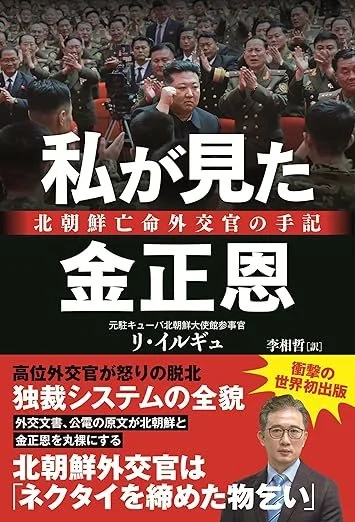
Source: Amazon.